For the complete documentation index, see llms.txt. This page is also available as Markdown.

Configuration

6X Series Sensors Configuration

Introduction

The configuration page is used to change:

  • How the 6X interacts with the aircraft it is connected to.

  • The triggering method

In most cases the 6X is preconfigured based on what aircraft/system the camera is ordered for and the configuration doesn't need to be changed.

If using the Inspired Flight RTK PPK Module please ensure the sensor is set to the Sentera GNSS configuration. View the Support link below for information on changing sensor configuration. 6X Sensor | Sentera Support

To learn how to change the configuration of the 6X or change the overlap for stand-alone mode, see the pages linked below.


How To Instructions

How To Change Overlap SettingsHow To Change Configuration

Platform/Metadata Configuration

The platform and metadata configuration is used to tell the 6X what aircraft it will be used with and where data sources (altitude, GPS, heading, etc) will come from.

Config File

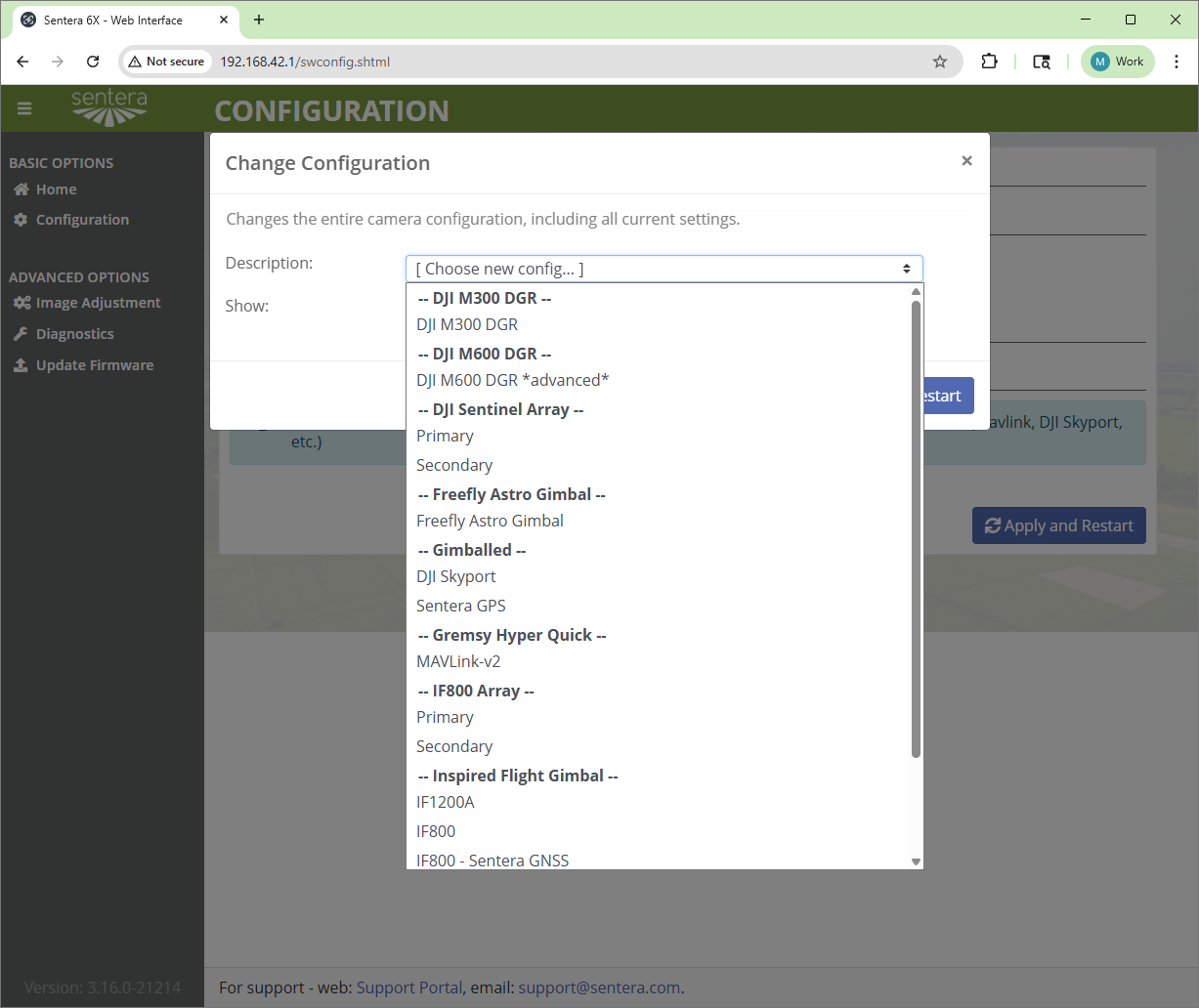
The Config File field will display the currently config file. It also contains the change button used for changing the config file.

Depending on the current config file there will be limited config files displayed in the change menu. To display all configuration file options select the "All platform configurations" and/or the "Advanced configurations" radio buttons as shown in the advanced tab below.

Config Type

The Config Type is tied to the config file and gives more specific instruction about the metadata sources. The config names and data source information are listed below.

Name
GPS Source
Attitude Source
Trigger Source
Platform Complatibility

DJI Skyport

DJI Autopilot

DJI Autopilot

DJI Autopilot

M300 M350 M200 M210

Sentera GPS

Sentera External GPS

6X Sensor Internal IMU

6X Sensor

M300 M350 M200 M210

Astro

Alta X Gen II IF800 IF1200 Custom

Name
GPS Source
Attitude Source
Trigger Source
Platform Complatibility

Freefly Astro Gimbal

Astro Autopilot

Astro Autopilot

Astro Autopilot

Astro

Alta X Gen 2

Astro Autopilot

Astro Autopilot

Astro Autopilot

Alta X Gen 2

Name
GPS Source
Attitude Source
Trigger Source
Platform Complatibility

IF800

IF800 Autopilot

IF800 Autopilot

IF800 Autopilot

IF800

IF800 - Sentera GNSS

Sentera RTK PPK Module

IF800 Autopilot

IF800 Autopilot

IF800

IF1200A

IF200 Autopilot

IF200 Autopilot

IF200 Autopilot

IF1200

IF1200A - Sentera GNSS

Sentera RTK PPK Module

IF200 Autopilot

IF200 Autopilot

IF200

Name
GPS Source
Attitude Source
Trigger Source
Platform Complatibility

MAVLink-V2

MAVlink Autopilot

MAVlink Autopilot

MAVlink Autopilot

Custom MAVlink Autopilot Systems

Name
GPS Source
Attitude Source
Trigger Source
Platform Complatibility

DJI M300 DGR

Sentera DGR Sensor Package

Sentera DGR Sensor Package

Sentera DGR Sensor Package

M300 M350

DJI M600 DGR

Sentera DGR Sensor Package

Sentera DGR Sensor Package

Sentera DGR Sensor Package

M600

Name
GPS Source
Attitude Source
Trigger Source
Platforms

DJI M600 OSDK

DJI A3 Autopilot

DJI A3 Autopilot

DJI A3 Autopilot

M600

MAVlink

MAVlink V1

MAVlink V1

MAVlink V1

Most MAVlink enabled platforms with configurable serial port.

Sentera GPS

Sentera GPS

6X Sensor Internal IMU

6X Sensor

Custom

Configurations with 6X Sensor Internal IMU as an Attitude source does not contain yaw/heading information.


Trigger

The trigger field is used to set the trigger type and related settings.

Trigger Type

The Command trigger type is used when the trigger commands come directly from the aircraft autopilot.

No settings are provided for this mode. The sensor will only trigger if it receives a trigger command from MAVLink, the web page, Payload SDK, or the custom Sentera Protocol.

The External trigger type is used when an external source is used to trigger the 6X.

There are 4 options for the external trigger commands. See the details in the table below.

Rising/Falling Edge

Low/High PWM

Mode
Description

Rising Edge

The trigger input must be stable for 50 milliseconds to register as a commanded trigger. This is also known as the mechanical switch debounce period.

Falling Edge

The trigger input must be stable for 50 milliseconds to register as a commanded trigger. This is also known as the mechanical switch debounce period.

Low PWM

The lower value of the PWM TRIGGER input in milliseconds.

High PWM

The higher value of the PWM TRIGGER input in milliseconds.

The trigger input is the TRIGGER signal on connector J2.

I/O

For all modes, the TRIGGER input must be actively driven using 3.3V logic levels.

The Interval trigger type is used to capture images at a specified time interval rather than distance travelled. The minimum capture interval is 0.200 seconds (5Hz).

The Overlap trigger type is used when the the 6X is being powered by an aircraft, not receiving triggers from the aircraft or an external device, and classical overlap settings are used. This is useful for many applications as it removes the need for in depth integration with the aircraft. The 6X in combination with the Light Sensor/GPS will operate without direct communication with the aircraft.

Once 6X detects it is more than the minimum altitude above the takeoff point, it begins to capture images and continues to do so to achieve the correct image overlap. Triggering stops when it detects the platform has departed from the minimum altitude.

The 6X works with any ground station or flight controller in this mode, as it makes calculations about altitude using the GPS receiver’s measured altitude at takeoff.

This is the standard setting for systems without MAVLink or DJI Skyport.

There are 2 overlap modes:

Auto Height (most common)

The 6X detects the flight altitude (AGL) based on the detected GPS altitude between where the session starts (on the ground) and where the aircraft flies at (survey altitude).

Fixed Height

The 6X assumes the survey altitude of the aircraft matches the fixed height input in the altitude box.

Item
Description

Overlap

Changes the frequency of the trigger based on the overlap of the image. Fifty percent overlap means that when the sensor has moved such that 50% of the image is new, an image will be triggered. Use the slider to adjust the overlap percentage in the text box. There are markers present in the slider at settings for typical use cases.

Altitude Type

Selects whether a fixed altitude is used for calculating overlap, or automatic altitude determined from GPS.

Atlitide

Selects whether a fixed altitude is used for calculating overlap, or automatic altitude determined from GPS.

Min AGL

To prevent triggers from occurring while walking around on the ground, a minimum altitude can be set. Any triggers that occur due to the sensor moving around will be blocked if the sensor estimates that its altitude is less than this number.

Min Distance

If the sensor is flying very low to the ground, the overlap setting may result in very rapid triggers. To prevent a flood of images, a minimum trigger distance can be set. This distance is the minimum distance the sensor must travel before the next trigger can be sent.

Last updated